
SIGNED GENERAL ROBERT E. LEE VANNERSON CDV PHOTOGRAPH WITH PRESENTATION
$6,500.00
Our Catalog
Updated
10/30/2026
Make a choice from any of our categories below
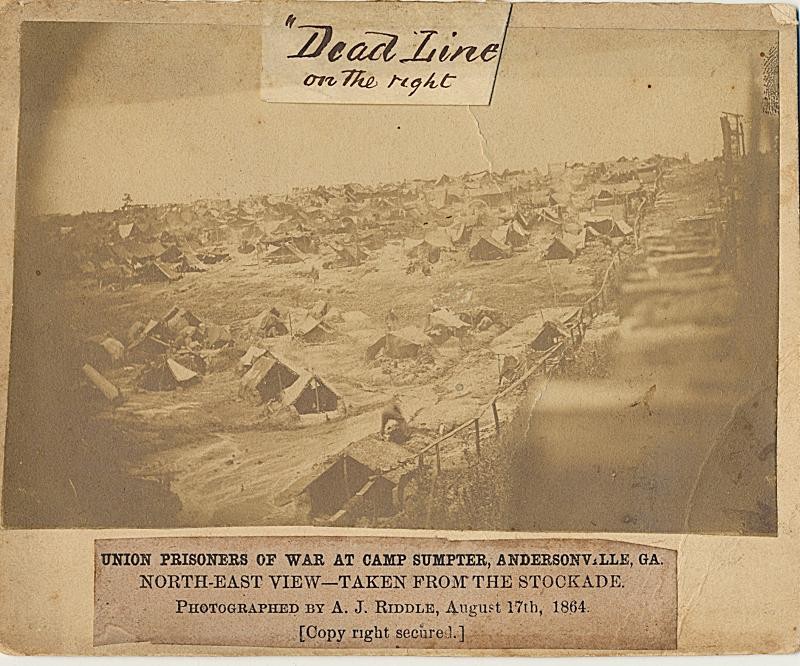
Exceptional original Civil War photograph of Andersonville Prison, Georgia, taken by noted Confederate photographer Andrew Jackson Riddle on August 17, 1864, at the height of the prison's overcrowding. The original printed caption beneath the image reads:
"UNION PRISONERS OF WAR AT CAMP SUMPTER, ANDERSONVILLE, GA. / NORTH-EAST VIEW—TAKEN FROM THE STOCKADE. / PHOTOGRAPHED BY A. J. RIDDLE, August 17th, 1864. / [Copyright secured.]”
A period manuscript label affixed above the image identifies the most important feature in the photograph: "Dead Line on the right.” Close examination of the original photograph reveals numerous Union prisoners scattered among the crude shelters inside the stockade, making this considerably more than simply an architectural view of the prison. The notorious deadline itself can be followed along the right side of the scene.
The photograph is an original albumen print mounted to period card stock, constructed in essentially the same manner as a Civil War carte-de-visite but in a larger format. The photographic image measures approximately 4½ x 3¼ inches, with the complete card measuring approximately 5¾ x 3¾ inches. This is particularly noteworthy because original Riddle Andersonville albumen photographs in major institutional collections have very similar image dimensions. The Metropolitan Museum of Art, for example, holds a Riddle South-west View of the Stockade, Showing the Deadline measuring approximately 4¾ x 3⅛ inches and identifies it as an albumen silver print made from a glass negative.
The deadline was one of the defining features of Andersonville. Camp Sumter's stockade enclosed approximately 26½ acres after its June 1864 enlargement. About nineteen feet inside the main stockade wall ran a low wooden rail that prisoners were forbidden to cross. Guards occupying the elevated "pigeon roosts” were authorized to fire upon prisoners entering the restricted area. At Andersonville's greatest overcrowding in August 1864, approximately 33,000 Union prisoners were confined there—the very month in which Riddle made this photograph. During the prison's fourteen months of operation, approximately 45,000 Union soldiers passed through Andersonville.
Andrew Jackson Riddle and the Andersonville photographs
Andrew Jackson Riddle (1828–1897) was a professional Southern photographer associated with Macon, Georgia, and one of the relatively few photographers to work in an official capacity for the Confederate military. His Andersonville series remains among the most historically significant photographic records produced within the Confederacy during the war.
Riddle arrived at Andersonville on August 16, 1864, reportedly for the purpose of photographing General John H. Winder and prison commandant Captain Henry Wirz. The following day he turned his camera toward the prison itself. He was assisted by Union prisoner Sergeant Warren L. Goss of the 2nd Massachusetts Heavy Artillery, whose later detailed descriptions of the Riddle photographs survive with the Gilder Lehrman collection. Riddle photographed the stockade from several directions as well as scenes of prisoners, ration distribution, the cemetery and burial parties.
These photographs are remarkable because they were made while Andersonville was still an active Confederate military prison. They are not postwar reconstructions. The men, shelters, guard towers, and deadline appearing within them were photographed as they actually existed in August 1864. The Metropolitan Museum describes Riddle's Andersonville pictures as extraordinary surviving wartime landscape photographs by a Confederate photographer and records that his images were later copyrighted in New York and sold after the war.
Original Riddle photographs survive today in such institutions as the Library of Congress, Metropolitan Museum of Art, Gilder Lehrman Institute, Nelson-Atkins Museum and Chrysler Museum of Art. Surviving examples appear in more than one photographic process and mounting configuration; importantly, period albumen prints from Riddle's glass negatives are documented in museum collections.
The subject matter of this particular view gives it additional historical importance. The deadline is plainly identified, and examination under magnification reveals the actual Union prisoners within the enclosure. The photograph therefore records not merely the site of Andersonville but men living inside the prison while it was at or near its maximum population.
Lewis W. Leeds provenance
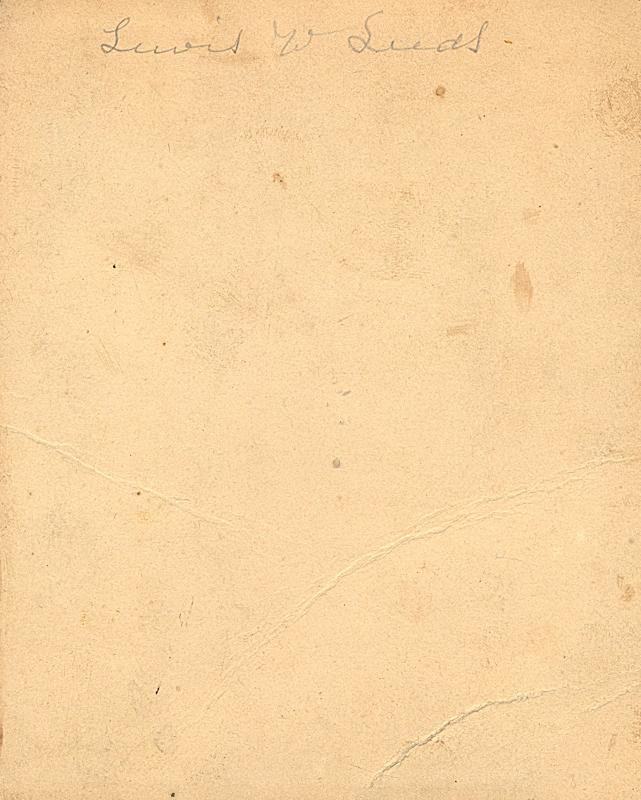
Adding considerably to the importance of this example is the period pencil signature "Lewis W. Leeds” on the reverse of the original mount, indicating ownership by Lewis W. Leeds, an important Civil War-era sanitary engineer whose professional work was directly concerned with the health and living conditions of United States soldiers.
Leeds served during the Civil War as Special Agent of the Quartermaster-General for the Ventilation of Government Hospitals. Following the war he became Consulting Engineer of Ventilation and Heating for the United States Treasury Department. His official wartime title is recorded on the title page of his own Lectures on Ventilation, based upon lectures delivered at Philadelphia's Franklin Institute during the winter of 1866–67 and published in New York in 1869. The Library of Congress also preserves his 1868 copyright registration for the work.
Leeds was an early and outspoken advocate of improved ventilation and sanitary conditions in hospitals and other crowded buildings. His wartime experience included examination of military hospitals, and his later writings specifically discuss ventilation problems he encountered in Washington hospitals used during the war and the improvements made to government hospital ventilation.
That association gives Leeds' ownership of this particular photograph unusual historical resonance. Andersonville represented virtually the opposite of the sanitary principles to which Leeds devoted his wartime career: extreme overcrowding, inadequate shelter, insufficient sanitation and disease. An original photograph documenting the conditions endured by Union prisoners and Southern prisoners alike would therefore have had particular relevance to a man professionally engaged in the health and sanitary welfare of soldiers.
The simple pencil "Lewis W. Leeds” on the reverse is characteristic of a personal ownership inscription rather than a later descriptive notation. Taken together with the photograph's period construction and Riddle's original printed identification, the Leeds signature provides an important and highly appropriate provenance linking this extraordinary photographic record of Andersonville with a Federal official whose Civil War work centered upon military health and sanitation
A rare and historically compelling original A.J. Riddle Andersonville photograph, taken on August 17, 1864, showing the notorious deadline with Union prisoners actually visible within the prison enclosure. Original albumen photograph measuring approximately 4½ x 3¼ inches mounted on period card measuring 5¾ x 3¾ inches overall. The original Riddle caption remains beneath the photograph, while a manuscript notation above identifies the "Dead Line on the right.” Most significantly, the reverse bears the period pencil ownership signature "Lewis W. Leeds,” Civil War Special Agent of the Quartermaster-General for the ventilation of U.S. government hospitals and later consulting engineer for the U.S. Treasury Department.
A remarkable convergence of Civil War photography, Andersonville history, and identifiable wartime provenance is offered by Richard Ferry Military Antiques. Florida's largest Civil War Dealer.
If you have ordered an antique weapon or artifact from our website please be advised that these guns are sold strictly as collectible antiques.
FloridaConfederate.com strongly recommends that these artifacts be enjoyed and appreciated for their historical significance and not ever fired. By ordering you are acknowledging these facts, warnings and assume full responsibility for your personal actions with regard to them.
We DO NOT sell modern guns, all our inventory will be pre 1898 and are classified by the ATF as antiques and require no government paperwork to own.