
MENDENHALL, JONES & GARDNER TYPE III CONFEDERATE RIFLE

$24,500.00
Our Catalog
Updated
10/6/2026
Make a choice from any of our categories below
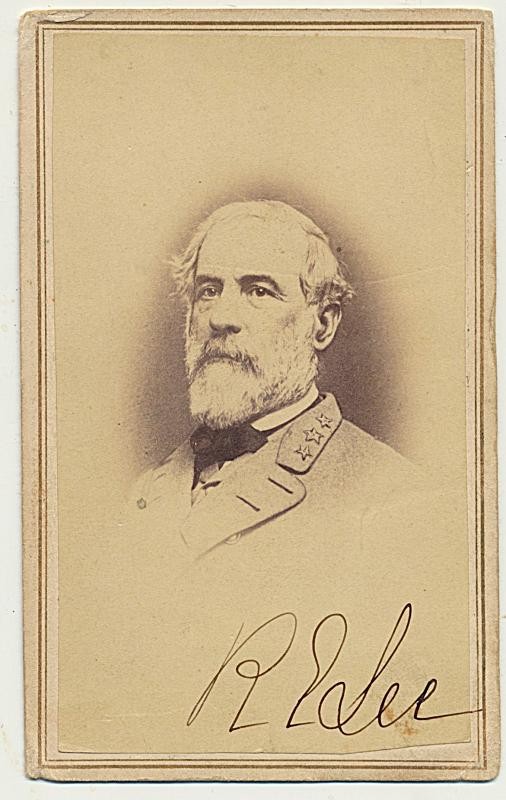
Signed Robert E. Lee Carte de Visite, Presented by Mary Custis Lee to "Miss Mary Ringold,” Lexington, March 16, 1866
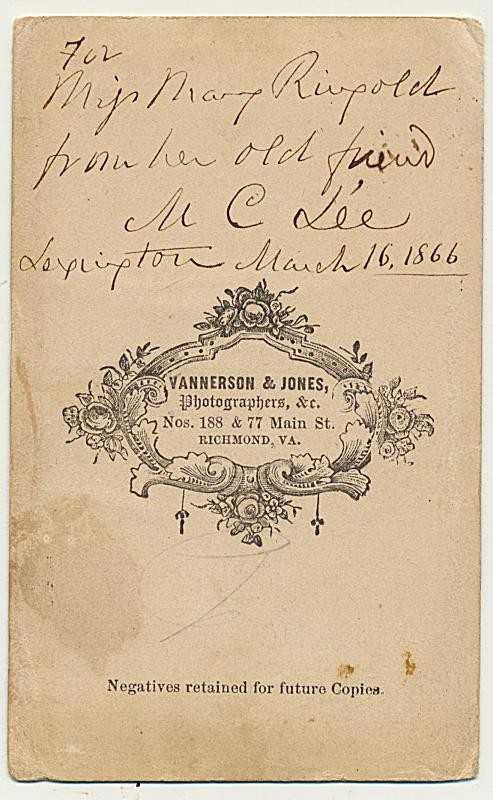
An exceptional post-Civil War carte de visite of General Robert E. Lee, photographed by the important Richmond firm of Vannerson & Jones, bearing a large original ink signature of Lee on the front and an extraordinary presentation inscription on the reverse from his wife, Mary Anna Randolph Custis Lee, to her longtime friend Miss Mary Ringold, dated at Lexington, Virginia, March 16, 1866. The portrait depicts Lee in Confederate uniform in a bust-length pose, his familiar white beard and three stars of a Confederate general clearly visible on the collar. Most importantly, across the lower portion of the image, Lee has boldly signed the photograph in ink:
"R E Lee”
Extraordinary Presentation Inscription from Mary Custis Lee
Also important historically is the period ink inscription occupying the upper portion of the reverse. In Mrs. Lee’s hand it appears to read:
"For
Miss Mary Ringold
from her old friend
M C Lee
Lexington March 16, 1866”
The inscription deserves particular attention. Mrs. Lee did not simply identify herself or present the photograph formally; she refers to Mary Ringold as "her old friend.” That intimate wording strongly suggests a personal relationship extending back well before the end of the Civil War. The place and date are equally significant. By March 1866 Robert E. Lee was living in Lexington, Virginia, where he had accepted the presidency of Washington College the previous autumn. The photograph therefore represents a deeply personal presentation made during the first year of the Lees’ postwar life in Lexington, less than a year after Appomattox.
Who Was Miss Mary Ringold?
Research strongly suggests that the recipient may have been Mary Digges Galloway Ringgold, usually styled Mary D. G. Ringgold, born in 1800 into one of the most prominent interconnected families of Maryland and Washington society.Mary was the eldest daughter of Tench Ringgold and Mary Christian Lee Ringgold. Tench Ringgold became a prominent Washington businessman and served as United States Marshal for the District of Columbia during the administrations of James Monroe and Andrew Jackson. He moved among some of the most influential political and social figures of early Washington. Mary’s mother, Mary Christian Lee, connected her directly with the distinguished Maryland Lee family. Her maternal grandfather was Thomas Sim Lee, twice governor of Maryland and a major Maryland planter. Contemporary Maryland chancery records specifically identify Mary Digges Galloway Ringgold among the descendants and heirs of the Lee and Digges estates. Her names themselves reflected this ancestry: Digges, Galloway, Lee, and Ringgold represented several long-established Maryland families. A modern study of the family describes Mary as the first-born daughter of Tench Ringgold and Mary Christian Lee and notes that she never married. That unmarried status is particularly important because Mrs. Lee addresses the recipient of this photograph specifically as "Miss Mary Ringold.”
For some time, one genealogical source gave Mary D. G. Ringgold a death date of 1862. That date caused understandable doubt about the identification. However, the newly located Baltimore City Directory for 1870 lists Mary D. G. Ringgold residing at 99 North Charles Street, Baltimore, demonstrating that a woman of this exact name was living well after 1862 and, critically, after the March 1866 presentation date. That evidence removes the principal chronological objection to identifying her as the recipient of this photograph.
The Elizabeth Keckley Connection — A Remarkable Link to Mrs. Lee
Perhaps the most fascinating evidence connecting Miss Ringold directly with Mary Custis Lee comes from the memoir of Elizabeth Keckley, one of the most notable African American women of nineteenth-century Washington.Keckley had been enslaved before purchasing her freedom and eventually became one of Washington’s most sought-after dressmakers. She later became dressmaker and confidante to First Lady Mary Todd Lincoln.In her 1868 memoir, Behind the Scenes; or, Thirty Years a Slave, and Four Years in the White House, Keckley described her early attempts to establish herself professionally in Washington. Among her patrons was a woman she called "Miss Ringold.”
The connection becomes remarkably specific.
Keckley wrote that she was visiting the Ringolds when she encountered Mrs. Captain Lee — Mary Custis Lee. Mrs. Lee was preparing to attend the important Washington dinner honoring the visiting Prince of Wales, the future King Edward VII, in 1860. She had already purchased the silk for her dress but had not yet secured a dressmaker.
Keckley recalled:
"Miss Ringold recommended me…”
As a direct result of that recommendation, Keckley received the commission to make Mrs. Lee’s dress. The following day Keckley went to the Lee residence. Robert E. Lee himself was present and gave her $100 to purchase the appropriate trimmings, instructing her not to spare expense in the selection.
This small episode is historically important because it documents, in Keckley’s own firsthand account, that a Miss Ringold was personally acquainted with Mary Custis Lee before the Civil War and was sufficiently trusted by Mrs. Lee to recommend a dressmaker to her. That documented 1860 relationship fits the wording on this photograph six years later with remarkable precision:
"Miss Mary Ringold — from her old friend — M C Lee.”
While additional documentary evidence would be desirable before calling the identification absolutely conclusive, the convergence is compelling: an unmarried Mary D. G. Ringgold of the correct social circle, directly connected through the Lee family; an independently documented "Miss Ringold” who knew Mary Custis Lee in 1860; and an 1866 presentation photograph from Mrs. Lee to "Miss Mary Ringold,” whom she explicitly calls her "old friend.”
Vannerson & Jones — Richmond Photographers of the Confederacy
The photographic imprint on the reverse is itself significant.
Within an elaborate floral cartouche is printed:
"VANNERSON & JONES,
Photographers, &c.
Nos. 188 & 77 Main St.
RICHMOND, VA.”
Below appears:
"Negatives retained for future Copies.”
Vannerson & Jones was one of Richmond’s important photographic firms during the Civil War era. The partnership of Julian Vannerson and Charles E. Jones operated in Richmond beginning during the wartime period, producing cartes de visite and portraits of Confederate officers, soldiers and prominent civilians. Surviving examples bearing the 188 & 77 Main Street imprint are held by the Library of Congress, including wartime portraits of figures such as Confederate cavalryman John S. Mosby and Brigadier General Seth Maxwell Barton.
Julian Vannerson was himself an important Southern photographic artist. Examples carrying his individual No. 77 Main Street imprint also survive in the Library of Congress. The partnership eventually dissolved when Vannerson acquired Jones’s interest; the Richmond photographic establishment later passed to John and William Davies and became known as the Lee Gallery. The Vannerson & Jones imprint is particularly desirable on a Robert E. Lee photograph because the firm photographed many of the Confederacy’s leading military figures and produced recognized wartime portraits of Lee himself. The Library of Congress holds an original Vannerson & Jones carte de visite of Robert E. Lee in Confederate uniform dating to the Civil War period. Thus the backmark is considerably more than a photographer’s advertisement—it associates this portrait with one of the principal Richmond photographic establishments working within Lee’s own wartime environment.
Importance of Lee’s Signature
Ultimately, the central feature remains the original signature of Robert E. Lee himself.The strong "R E Lee” autograph was placed prominently across the lower front of his own portrait. Signed photographic images occupy a special place within Lee material because they combine two highly collectible forms of Civil War history: an original nineteenth-century photographic likeness and a genuine autograph of the Confederate commander. This example, however, carries an additional level of historical interest that ordinary signed Lee photographs do not possess: it retains a personal presentation from Mrs. Lee to a woman she calls her "old friend,” with place and exact date, and research provides a credible identification of that recipient within Mrs. Lee’s documented prewar social circle.
Historical Significance
Taken as a whole, this is considerably more than a signed portrait of Robert E. Lee.
It combines:
- an original Vannerson & Jones Richmond carte de visite of Lee in Confederate uniform;
- a large original "R E Lee” autograph on the photograph itself;
- the distinctive wartime-era Vannerson & Jones, Nos. 188 & 77 Main Street backmark;
- an extensive contemporary presentation inscription from Mary Custis Lee;
- the exact place and date, Lexington, March 16, 1866;
- and a probable recipient, Mary Digges Galloway Ringgold, whose family and social connections place her squarely within the Lees’ prewar Washington world.
Most remarkably, Elizabeth Keckley’s memoir independently documents a Miss Ringold introducing Keckley to Mrs. Lee in 1860, resulting in Keckley making Mrs. Lee’s dress for the Prince of Wales dinner and meeting Robert E. Lee himself. Six years later, Mrs. Lee presented this signed portrait of her husband to "Miss Mary Ringold” and described her simply and affectionately as "her old friend.” An exceptional association piece joining Robert E. Lee, Mary Custis Lee, the Ringgold family, and Elizabeth Keckley, accompanied by one of the most desirable features possible on a Civil War photograph—the bold original signature of General Robert E. Lee himself.
Richard Ferry Military Antiques — Florida’s largest Civil War dealer.
If you have ordered an antique weapon or artifact from our website please be advised that these guns are sold strictly as collectible antiques.
FloridaConfederate.com strongly recommends that these artifacts be enjoyed and appreciated for their historical significance and not ever fired. By ordering you are acknowledging these facts, warnings and assume full responsibility for your personal actions with regard to them.
We DO NOT sell modern guns, all our inventory will be pre 1898 and are classified by the ATF as antiques and require no government paperwork to own.